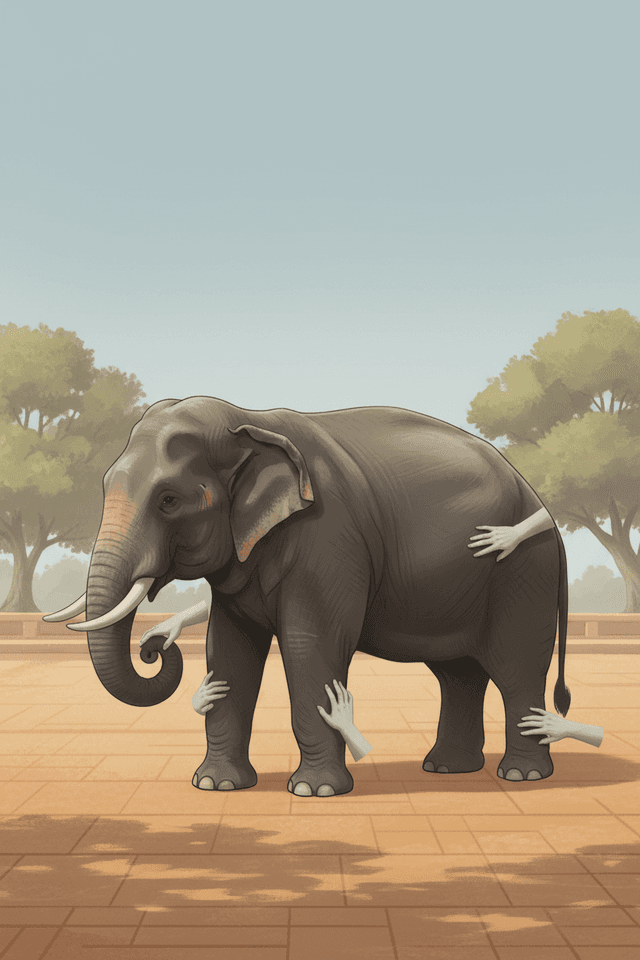
Several people who could not see were brought near an elephant. One person touched its leg and concluded that an elephant was like a pillar. Another touched its tail and thought it was like a rope. Someone else felt the trunk and compared it with a thick pipe. Others touched the ear or side and formed still different descriptions.
Each person had experienced something real, but each mistook a part for the whole. Soon they argued because each was certain that his own description was complete. A wiser observer explained that their observations were not worthless; they were partial.
The Jain philosophical tradition uses this kind of story to illuminate anekantavada, the idea that reality is many-sided and that a single limited viewpoint may not exhaust the truth. The lesson is not that every claim is equally correct. It is that careful understanding requires recognizing what a viewpoint can and cannot establish.