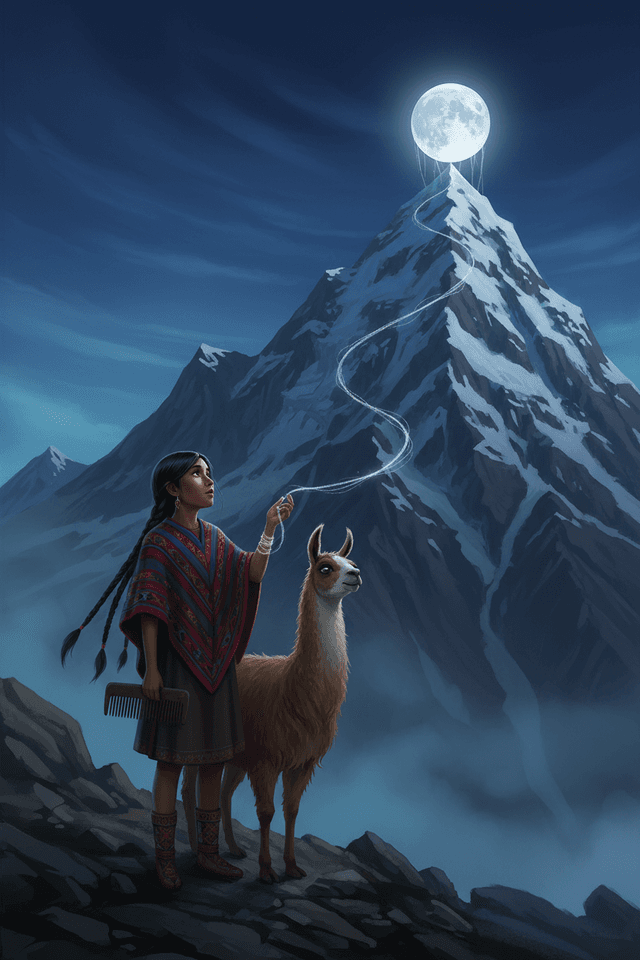
The night the moon got stuck on the mountain, Sumaq was the only person in the village who was still awake to see it happen.
She was sitting at her grandmother's loom by the light of a candle, finishing the last row of her weaving for the festival competition. It was the most beautiful thing she had ever made. It was as long as her arm and as wide as a doorway, woven from the softest alpaca wool, dyed in the old colours: red from the cochineal beetles that lived on the cactus, yellow from the flowers on the hillside, deep blue from the indigo her grandmother bought at the market in Cusco. It showed the mountains and the river and the terraces of the village, row after row, and in the corner, a little brown llama with a white patch on its nose.
The llama was Pichu. Pichu was asleep in the corner of the room, snoring, because he had decided many years ago that he was not a llama who slept outside.
Sumaq tied off the last thread, and stretched, and looked out of the window at the moon. And the moon was not moving.